
Discount Rate Modelling
At Lotus Amity when we prepare a business valuation we carry out discount rate modelling. Discount rate modelling is an intricate and essential component of a business valuation.
The intrinsic value of a business, using the Discounted Cash Flow Method, is simply a function of two components:
- Expected future cash flows
- The risks associated with those future cash flows
The discount rate reflects point number 2 – the risks associated with future cash flows. The discount rate is the rate of return that investors expect to receive to reflect the level of risk. The discount rate effectively reduces the value of a future cash flow to a lower value today. The higher the discount rate the lower the value today
Business valuation and discount rate modelling
The International Valuation Standards refer to the following four common methods for developing an appropriate discount rate (IVS 103, paragraph 20.31):
- Capital Asset Pricing Model (CAPM)
- Weighted Average Cost of Capital (WACC)
- Observed or inferred rates and yields
- Build-up-Methods
At Lotus Amity we often use an extension of the Capital Asset Price Model to estimate a cost of equity. The cost of equity is the return required by shareholders.
To calculate the discount rate, which is the cost of capital for the business, we use a weighted average cost of capital. The weighted average cost of capital reflects both the return required by shareholders and the return required by debt holders.
The International Valuation Standards also state that a valuer should consider corroborative analysis to assess the appropriateness of a discount rate. At Lotus Amity our corroborative analysis includes comparing the implied multiples from the Income Approach with guideline company market multiples and or transaction multiples (IVS 103, paragraph 20.32 (c)).
Return on equity calculation
According to Modern Portfolio Theory (MPT), investors are assumed to be risk averse. Investors will only accept increased risk in an investment portfolio if they are compensated by higher returns.
Modern Portfolio Theory is an extension of the theory of diversification. According to the theory, investors can reduce overall risk by investing in a variety, a portfolio, of different assets. Consequently, according to Modern Portfolio Theory, the risk and return of an asset should not be assessed by itself but by how the asset contributes to the overall risk of the portfolio.
The Capital Asset Price Model is based on Modern Portfolio Theory. The model describes the relationship between an expected investors return and the risk of investing in an asset. The model estimates the expected returns required by an investor as equal to a risk-free rate plus a market risk premium, see the formula below.
CAPM formula

Return on equity inputs
Lotus Amity often uses the Commonwealth Government ten-year bond yield as a measure of the risk-free rate. This assumes that nominal cash flows are used, i.e.the cash flows reflect inflation. Sometimes, the subject asset may have a shorter life and a shorter bond-yield is appropriate. Occasionally, real cash flows (adjusted for inflation) are required and so the Commonwealth Government indexed ten-year bond yield is used.
To estimate the equity risk premium, we often refer to historical studies, such as the worldwide equity risk premium studies carried out by Griffiths University, and forward equity risk premiums in the market.
There are two key types of financial risk: market risk and firm risk. Market Risk is the vulnerability to events, such as changes in economic conditions, which affect all market returns. Firm Risk is the vulnerability to events in which only specific industries are exposed.
Importantly, CAPM only estimates the rate of return of an asset in relation to a well-diversified portfolio. Beta only reflects the extend a company’s performance can be explained by the market’s performance. Consequently, CAPM only reflects Market Risk.
At Lotus Amity we principally value privately held businesses. Investor owners in privately held businesses often do not have the luxury of the business being part of a diversified portfolio. All the owner’s eggs may be in the one business basket. The owner investors are exposed to both Market Risk and Firm Risk.
Consequently, at Lotus Amity we adjust beta to reflect not only Market Risk but also Firm Risk. This adjusted beta reflects the volatility (standard deviation)of the total returns of a company compared to the volatility in the returns of the market.
Follow this link for details on private company discount rates and the issue of diversification.
Discount rate
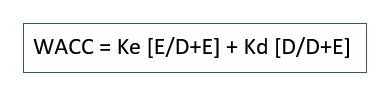
Companies raise finance from a variety of sources which are either equity-based, debt based or a hybrid of the two. A company’s cost of capital, the discount rate, is the combined rate of the return required by equity holders and debt holders.
At Lotus Amity we calculate a company’s cost of capital (the discount rate) by weighting the equity and debt returns according to the respective amounts of equity and debt. This is known as the Weighted Average Cost of Capital (WACC) and is calculated using the equation below. Where Ke is the cost of equity, Kd the cost of debt, E the value of equity and D the value of debt. The cost of debt is the after-tax cost of debt.